

Hollandia truffles are the sclerotia of a cultivated Psilocybe strain, grown in the Netherlands and sold fresh in vacuum packs of 15 grams. Shops market Hollandia as one of their strongest truffles and recommend it for people who already know how psilocybin affects them.
Truffles are sclerotia, not mushrooms
A "magic truffle" has nothing to do with culinary truffles. It is a sclerotium: a hard, compact mass of fungal tissue that some Psilocybe species form under the substrate to store nutrients and survive dry or cold periods. Sclerotia look like small, pale brown lumps, a bit like ginger or walnuts, and contain the same active compounds as the mushrooms of those species: psilocybin, which the body converts into psilocin.
Only a handful of Psilocybe species are known to form sclerotia. The ones commonly sold as truffles include P. tampanensis, P. mexicana, P. atlantis and P. galindoi (Wikipedia overview with references). The distinction between truffle and mushroom matters legally in the Netherlands, as the legal status page explains.
Which species is Hollandia
Nobody selling it says. "Hollandia" is a trade name, and the label "Psilocybe Hollandia" that some shops use is not a species name: the global species database GBIF has no species of that name, only the genus. Hollandia is a selected, cultivated strain, and its parent species has not been published. Avalon also calls it "Psychonauts Delight".
That leaves a few things unknown that would be useful to know: how the strain was selected, whether the potency is stable from batch to batch, and how much psilocybin a typical pack contains. We have found no published laboratory measurement of Hollandia truffles specifically. Be wary of any exact milligram figure you see online for this strain unless it comes with a named laboratory or study.
What the seller says
Avalon Magic Plants, which sells Hollandia and publishes this site, describes the strain as follows. These are the shop's own statements, not independent findings:
- Contains an estimated twice as much psilocybin as Atlantis.
- Grown in the Netherlands through years of selection for potency.
- Taste comparable to walnuts, with less of the sour aftertaste of some other truffles.
- Effects usually start within an hour and last four to six hours.
- Advised dose: 7.5 grams (half a pack) for people new to Hollandia, 15 grams for experienced users.
The strength claim is the important one, and the strength page looks at what it can and cannot mean.
What is in a pack
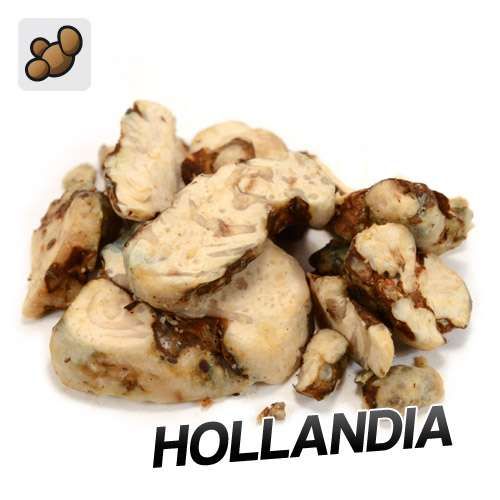
A standard pack holds 15 grams of fresh truffles, vacuum sealed. Fresh truffles are mostly water. They look like irregular lumps between the size of a pea and a large walnut, light brown on the outside and paler inside.
Blue or dark spots appear where psilocin oxidises after damage or with age. They are harmless, but a truffle with a lot of blue has lost some potency. Truffles that smell sour, feel slimy or show fluffy mould are spoiled.
How long they keep
Keep the pack closed and in the fridge. Avalon advises 2 to 4 °C, at which the truffles keep for up to a month. Once the vacuum is broken, use them within a day or two.
Drying them is also a bad idea in the Netherlands. Fresh truffles are outside the Opium Act, but the status of dried truffles has not been settled, and the Jellinek classes them as a List I drug (Jellinek), the same list as cocaine.
Hollandia in the truffle range
Shops sort their truffles roughly from mild to strong. Mexicana and Pajaritos sit at the mild end, Atlantis and Tampanensis in the middle, and Hollandia with a few other house strains at the strong end. That order is useful as a rough guide and nothing more. It is based on grower information and customer feedback, and the difference between two packs of the same strain can be larger than the difference between two neighbouring strains.
Continue with how strong Hollandia is or go straight to dosage.